Showing posts with label Dilemma Resolution. Show all posts

Saturday, February 18, 2023

Dilemma resolution

कर्मण्येवाधिकारस्ते मा फलेषु कदाचन |

मा कर्मफलहेतुर्भूर्मा ते सङ्गोऽस्त्वकर्मणि || 47 ||

"You have the right to work, but never to the fruit of work.

You should never engage in action for the sake of reward,

nor should you long for inaction."

"You have a right to perform your prescribed duties, but you are not entitled to the fruits of your actions. Never consider yourself to be the cause of the results of your activities, nor be attached to inaction.

The Bhagavad Gita teaches us ways of living. Scripture is very practical. You will find answers for everything. Whenever I struggle for something, I refer to it.   Recently I encountered some questions related to dilemma and dilemma resolution. 

Arjuna was on the brink of a great battle, one that would decide the fate of his kingdom and his people. But as he looked out at the opposing army, he saw many of his own friends and family members among the ranks of his enemies. Overwhelmed with emotion, Arjuna turned to his charioteer, Lord Krishna, and confided in him his dilemma.

"How can I fight against my own kin, my own people?" Arjuna asked Krishna. "It is better to renounce this fight and live in peace."

Krishna, who is an incarnation of the god Vishnu, knew that Arjuna's dilemma was a difficult one. But he also knew that Arjuna had a duty to uphold as a warrior and as a prince.

"Arjuna, you are thinking about this battle in the wrong way," Krishna said. "You are not fighting against your own people, you are fighting for righteousness and justice. You have a duty to protect your people and your kingdom, and that duty requires you to fight."

Krishna went on to explain to Arjuna the principles of dharma, or righteousness, and how it was his duty as a warrior and a prince to uphold these principles. He reminded Arjuna that the soul was eternal and that death was simply a transition to another state of being.

"Know that which pervades the entire body is indestructible. No one is able to destroy the imperishable soul." Krishna said.

Arjuna listened to Krishna's words and his mind was cleared of all doubts. He picked up his bow and arrow and prepared to fight. With Krishna by his side, he entered the battle with courage and conviction. In the end, he emerged victorious, and his people were saved from the threat of invasion.

The story of Arjuna and Krishna's conversation is told in the Bhagavad Gita, one of the most important texts of Hinduism. It is a powerful reminder that even in the midst of the most difficult dilemmas, there is always a way to find a resolution. By turning to wise and knowledgeable people and by understanding and upholding our duties, we can overcome any obstacle that life presents us.

"Bhagavad Gita provides the great framework for resolving dilemmas based on the principles of dharma, or righteous duty. The process can be broken down into several steps"

Identify the dilemma: The first step in resolving a dilemma is to clearly identify the problem or issue at hand. In the case of Arjuna, he was faced with the dilemma of whether or not to fight in a battle against his own people.

Seek guidance: The second step is to seek guidance from a wise and knowledgeable person. In Arjuna's case, he turned to Krishna, who was an incarnation of the god Vishnu.

Seek knowledge: The wise person will provide knowledge about the nature of reality and the principles of dharma (your personal value system)  that should guide one's actions. In Arjuna's case, Krishna taught him about the eternal nature of the soul, the importance of upholding dharma, and the concept of detachment from the fruits of one's actions. The knowledge can be from your mentor, coach, any books you read or even your and your parents and elder’s past experiences.

Choose a course of action: After receiving guidance and knowledge, the individual should choose a course of action that aligns with dharma and upholds their duty. In Arjuna's case, he chose to fight in the battle as a duty to protect his people and uphold dharma.

Take action with detachment: The final step is to take action with a sense of detachment from the fruits of one's actions. This means that the individual should focus on performing their duty and taking action that aligns with dharma, without being attached to the outcomes or results of their actions.

Through this process of seeking guidance and knowledge, choosing a course of action, and taking action with detachment, an individual can resolve a dilemma in a way that upholds their duty and aligns with the principles of dharma. 

The Bhagavad Gita teaches that by following this process, we can find peace and fulfillment in our lives, even in the face of difficult dilemmas.

In resolving a dilemma, it is important to consider not just one's own self-interest, but also the interests of others and the greater good. This requires an understanding of the interconnectedness of all things and a recognition of our shared responsibility to uphold dharma and promote the welfare of all beings.

The Gita also teaches that dharma is not a fixed set of rules or principles, but is rather a dynamic and evolving concept that must be constantly re-evaluated in light of changing circumstances. This means that in resolving a dilemma, one must be flexible and adaptable, and willing to adjust their understanding of dharma as new information and perspectives emerge.

Ultimately, the Gita teaches that by following one's duty and upholding dharma, we can live a life of purpose and fulfillment, and contribute to the well-being of the world around us. Through this framework of ethical decision-making, we can navigate even the most difficult dilemmas with clarity and confidence, and find a path forward that is aligned with our deepest values and aspirations.

"However we should think about Karma before taking any action. Karma, which means "action" or "deed." It is often described as a wheel or cycle of cause and effect. Every action we take, whether good or bad, sets off a chain reaction that will eventually come back to us."

Please respond the survey, I am conducting, as a part of my research by clicking on >> Leadership Competencies required for managers while handling crisis situations. 

(Opinions are purely personal & does not represent my organizations, current or past) 

Author's books are available on Amazon, Flipkart, Pothi and BookGanga. You can buy the print copy of Vitality in Human Resources on amazon. Click >> Vitality in Human Resource: Adding human dimensions in HR processes    

Friday, December 24, 2021

Do you know how things work?

Mental Models 

There are issues, mysteries, and questions around us. On the other side there are solutions, resolutions and answers for everything. However managing those and finding appropriate solutions is the critical job. Everyone does this depending upon her/his experience and wisdom earned through the learnings and reflections. If you know how things can work in the real world, possibly you may find solutions fast. This is possible when you have some image in your mind on how to approach any situation. You are able to connect the dots and create the blueprint to reach the solution. 

Some examples of mental models are, understanding how demand can impact on the supply, how training can  positively impact on productivity, etc. or even addressing some issues, improving something, understanding behaviour of people and understanding some patterns etc etc. Mental models are how we understand the world. They shape what we think and how we understand. They shape the connections and opportunities that we see. By using mental models we simplify complexity, understand the logical sequence. To be accurate, of course we also need to understand the behaviour of others while preparing the model. 

Solutions can be products, services or simple answers addressed to something. The main function of mental models is to organize the area specific knowledge in order to lend subjective plausible phenomena and give them meaning. Processes of conceptual changes are postulated based on analogical thinking and strategies of successive model construction and completion. There are already ample mental models available in business, psychology, personality, science and so on. You can use those for handling the problems, however you can also define your mental models. 

It is a simple but effective tool to check how things work and implement the logical thought process while working on any initiative.

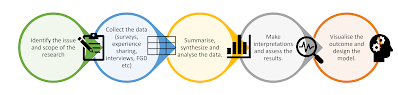
Process of creating mental models.

Process of creating Mental Model

  1. Identify the problem and scope,
  2. Collect the data through surveys, focused group discussions, interviews, or asking the experience of others. You can use your own experiences earned over a period of time. 
  3. Summarize and synthesize the data,
  4. Make interpretations and assess the results,
  5. Finally visualize the outcome and design the model based on the outcome.  

I recently created the “Industrial Relations Framework” based on the model and study, however I extensively used the research methodology. Please click here to read Industrial Relations Strategy Framework

(Opinions are purely personal & does not represent my organizations, current or past) 

Author's book are available on Amazon, Flipkart, Pothi and BookGanga. Income from books is used for social cause. 

Wish you all a happy X-mas and happy new year!

Sunday, December 20, 2020

To be or not to be...


In life we have to make different decisions. We have to decide on different alternatives and choices. Sometimes it is easy, sometimes difficult. Dilemma is a situation where you have difficult choices and you are not sure which you want to choose. Sometimes there are different possibilities that will have consequences which you don’t wish for. Most of the time, it is a conflict with two possible solutions. As a professional you are encountered in such situations regularly.  At leadership positions such situations are common.

We encountered situations related to values, ethics, morale and we have different choices. For example, you see the small kid begging at the signal. You become emotional and compassionate to see her, however you also believe that there is a beggars’ racket active. It is possible that if you give the money to beggars, it will encourage beggars’ racket. It is also creating the habit of begging and that kid will never learn to work hard. Here is a moral dilemma, to give the money or not?

Sometimes while solving the problem we focus on the correlation and not the causation. This mainly happens when there is a lot of data. Sometimes you see the correlations between different variables and solve the problem only focusing on co-relations. We miss the causation. Such types of situations also create a dilemma when you don’t see the link between correlation and causation. 

There are different dilemmas we face during our personal and professional life. Ethical, moral, values, legal and so on. In any case there is a conflict and you are not sure about the possible outcomes.

Dilemmas are good. It shows the character and traits of the person while resolving dilemmas. Generally, during interviews, few managers ask questions explaining a hypothetical situation and check the response. It is crucial how the person responds and resolves the dilemma. One of the simple examples is, “Your department is understaffed and there is a lot of pressure on performance. Your few employees are on leave and one employee to whom you expect in the office, calls you and requests the leave as his kid is sick. What and how will you act in such a situation?” Response may vary depending upon the person and you can get the clue about the personality from such responses, and his body language. The question is how you resolve dilemmas in your life. Sometimes something is legal but beyond your values.

We behave differently while dilemma resolution. In our life we have different values, some values are very strong where you would never compromise, some values are flexible and changing in nature depending upon the situation. 

On the 15th Day of Mahabharata war, Guru Dronacharya killed Virat and Drupada. This was a big setback to Pandavas. Arjuna was not able to defeat Guru Dronacharya. As far as Dronacharya held a weapon in hand, he was undefeatable. Lord Krishna knows this. To make him unarmed, he makes a plan, where Bhima kills one of the tuskers named Ashwatthama. Ashwaththama was a beloved son of Guru Drona. Bhima kills tusker and proclaims that he killed Ashwaththama. The news spreads like a fire and when Guru Drona hears this and thinks. “Could it be true?” He could not see his son and he got worried. To confirm this, he goes to the Yudhisthira, who was known for truthfulness and asks, “Has Bhim killed Ashwaththamma?” Now Yudhisthira is in a dilemma. His values were strong, how can he tell a lie. He replied, “Yes.” However, Yudhisthira had also uttered, "Naro va kunjaro va," to absolve himself of the sin of lying. Either a man or an elephant. He had chosen to broaden the zone of truthfulness and to blur the distinction between nobility and ignoble dishonesty. Somebody may say that it was unethical, but finally you have to think what is better for the larger and own group.

While resolving such dilemmas, you can follow the process in personal and professional life.

Understanding values and principles, challenging your inner self, inner conscience mind and your Intellectual intelligence. It is called “the principle of moral idealism”. It says that there is a clear distinction between good and bad, between what is acceptable and what is not and that the same is true for all situations. It therefore asks to abide by the rule of law without any exception. Another theory is there is a very thin line between good and bad. It totally depends upon the situation. What may be acceptable in a certain situation can be unacceptable at some other place. Some believe that the authority is competent to take the decision and they will use their intuition to understand what is good and what is bad.

Discuss and debate: Whenever you are in a dilemma, it is good to discuss and debate on different alternatives and consequences of the outcomes. You can use the 6 thinking hats process to investigate different aspects of the problem.

Engage different stakeholders in the organization if this is at organizational level. In personal life, engage with family members, spouse, parents and elders. They will give you a different perspective.

In the VUCA world, dilemmas are at every corner and step of life. It is bad, not to think and take decisions blindly. Dilemmas will test your inner strength and it is up to you what you want to be. Finally, you have to satisfy your inner conscience.   

Please read the print replica of my latest book written for leaders on amazon kindle, Vitality in Human Resource: Adding human dimensions in HR processes
(Opinions are purely personal & does not represent my organization)    


Author's book are available on Amazon, Flipkart and BookGanga


You may also like these.. please read