Showing posts with label Leadership Lessons. Show all posts

Sunday, November 13, 2022

Trusted Leadership

Creating the trust on leadership

"Businesses have evolved into something nearly unrecognisable compared to just two years ago. In this evolved and changed world, employees and customers are looking to leadership for guidance in the workplace."  

One of the important factors we need to think about is improving the trust capital in the organisation (please read Vinod Bidwaik : Trust Capital). However, leaders may have different opinions on how to create trust. Role modelling is missing and their limited understanding about the business and human capital is creating challenges within organisations. In fact the major weakness is they don’t know what exactly trust means. Most of the time, expectations are just to follow leaders without challenging their thought process. Lack of alignment from employees point of view is also the lack of trust on the leader. This is based on the experience employees get during the interaction with leaders. If employees don’t trust the leaders, it also means that employees are not engaged and aligned to the larger purpose. You will not see the impact short term. People still may work, achieve their results, or may just do what is told or expected, but the impact is long term.   


Leaders must also act as a guide in the midst of uncertainty. The high call of trusted leaders is to give as much clarity as possible during the VUCA world. Your fastest opportunity to build trust is in times of crisis and recovery, but it is also the time you can lose it most quickly. People don’t follow the leaders they don’t trust. 


When trust in teams goes up, people feel safe and valued so they are willing to share ideas and praise, which in turn leads to increased innovation and productivity. Trust builds psychological safety. 


How to improve trust in leadership?


Relationships: Networking and building relationships across the organisation is crucial nowadays. Relationships are primarily based on the emotional connections between employees and leaders. Sometimes title, position, poor listening skills, attitude, aggression and micro management keeps away employees from the manager. Sometimes, leaders have the blind spot of their behaviours, like managers spending more time with one team member can create the wrong perceptions in other team members. Perhaps the manager may have more stakes in the role of that person or it may be his favourite area and s/he may be doing it unintentionally but people perceive it differently. Even managers and employees living in the same area and if they are carpooling, other team members become insecure. This may lead to gossiping about the proximity between two. So as a leader, you need to build relationships so that all people get the feeling of equality.    


Clarity in communication: Communication is effective when you understand the next person. Trusted leaders speak from the heart. First they understand the audience and then decide their strategy to communicate. They demonstrate empathy and are effective in listening. It is not about showing what knowledge you have but being vulnerable and asking the right questions and saying, “I don’t know,” if they don’t know any subject.    


Role Modelling: People trust when you walk the talk. Unfortunately nowadays, all dnyan is for others and not for leaders. Nowadays sustainability is the buzzword. Every corporate leader is speaking about reducing carbon emission and the irony is that to explain sustainability, those leaders are travelling from one continent to another. People preaching on carbon emission have lavish offices with continuous running air conditioners and with luxury cars. So role modelling is very important when you want to believe people in leadership.   


Capabilities and Competencies: People will trust you when you have the functional, behavioural and leadership competencies and you are capable to manage the role you have taken. Continuous learning, being agile and relevant is the key to becoming competent. Unfortunately people speak a lot about but hardly implement in their behaviours.   


In Spite of having and doing good 100% people will not trust leadership. People still have their opinions and perceptions and those are built by them based on their experiences, right or wrong, with you. However, always keep doing good work, making a positive impact in the lives of people.


Please respond the survey, I am conducting, as a part of my research by clicking on >> Leadership Competencies required for managers while handling crisis situations

(Opinions are purely personal & does not represent my organizations, current or past) 

Author's books are available on AmazonFlipkartPothi and BookGanga. You can buy the print copy of Vitality in Human Resources on amazon. Click >> Vitality in Human Resource: Adding human dimensions in HR processes    

Royalty from books is used for social cause. 

Saturday, December 11, 2021

Don’t shy away from your failures

In any event or situation, success and failure are two possible outcomes. We become happy when we achieve success. We plan for success, we desire success, and we design our all efforts to get the success, however failures are also a part of life. We never plan for failures; we never imagine that something may go wrong.  In spite of putting our best efforts, we may fail. Falling flat on the face is not recognized and accepted easily. People assume that failures mean losing something. The fear of failure kills a lot of dreams. People don’t dare to take the risk. Once upon a time, failing was the routine for me. I was trying hard but then I was not getting desired results. When I started reflecting, I realized that I learnt a lot many things only because of failures. I understood the philosophy that there are no regrets in life, there are only lessons.  

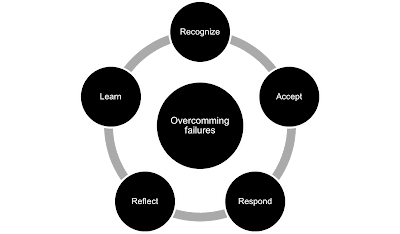
It is natural to feel bad when you are unsuccessful in spite of putting your best efforts. We are human beings, and we should recognize those feelings. I learnt a lot as I grew up. I use the following tactics to overcome the situation.

@vinodbidwaik

Recognize: Sometimes we have the tendency to justify the outcome by equalizing efforts to success. We feel bad and get disappointed. I look at this as one of the events in life and recognize the failures or issues.

Accept: Once you are clear that there is learning from such events, it is very easy to accept it.

Respond: After accepting, the situation, response is different. Instead of disappointment, frustrations, panics etc, the reaction can be converted into a positive response. For example: looking for the silver lining. There is always some learning. I believe that there are no regrets, only lessons.

Reflect: Taking the stock of the situation and reflecting on lessons learnt. It is always good to reflect and understand how we can do better next time.

Learn: Finally understanding what I learnt and development areas for me.

Never let success get to your head; never let failure get to your heart

(Opinions are purely personal & does not represent my organizations, current or past) 

Author's book are available on AmazonFlipkartPothi and BookGanga. Income from books is used for social cause. 

Sunday, December 05, 2021

Compassion and Empathy

Almost 70-80 employees were sitting and agitating against the company for their pending dues which the company could not pay on time. 

Those workmen were given the golden shake hand by the company before entering the joint venture with one of the reputed MNC. The workmen were given quite handsome severance package along with lifelong pension, medical cover for self and family. Once upon a time this company was a blue chip company, however company was not doing good. Company had applied to BIFR. One of the measures was to sell few businesses or have the JV with some good company. The MNC wanted to enter India, and it was a great opportunity for them to enter through the JV with majority stakes. It was a great opportunity for both. The main condition was new JV would hire only required employees with new employment conditions. It was clear that redundant employees would loss the job.

I was the HR Head of a newly joint venture organization. This issue was supposed to be handled by the minority company as they had an agreement with the workmen. 

What should we do in such a situation? It was a common gate for new JV company and another plant which they retained. The separation and integration plan were in the process. Few activities were as per the plan, but this agitation has put the hold on everything.

I had a discussion with the HR Head of that company who was operating from their corporate office. From the discussion, I got the impression that he was least interested to visit the plant and speak with the workmen. Our management was constantly in touch with the top management who was the ex-employer of agitating workmen. It was almost 3-4 days, workmen were sitting In front of the gate. Me and our plant head had a discussion and I suggested that why not speak with them and explain to them that they can take alternate actions instead of agitating In front of the company? We had a discussion with our CEO and he allowed us to go ahead. 

We visited the site to have a discussion with the workmen and a few leaders. Everybody started speaking and we just listened to them. We had a candid discussion with them, explaining that there is no point agitating in front of the gate as it is a totally different company, we also assured them that we will arrange their meeting with their ex-employer. I realized they were really struggling to meet the livelihood, because the financial issues, however nothing was in our hand. It was a hot summer. I asked the admin team to arrange the temporary pandal, fans and water arrangement for them. We also arranged snacks and tea for them every evening. It was a small gesture, but it helped to break the ice.

After two days, the managing director of the company visited the factory. He explained in detail why the payment got delayed. He was a good man; however, he was also struggling to arrange the funds to run the show. Finally, workmen agreed to take back their agitations on the assurance of their pay out by the managing director.   

This incident was a big learning experience for me. You may face situations for which you are neither responsible nor accountable, still you have to face those situations and help to solve the problem. This is the most difficult task when you don’t have any control on the situation, however you can face such incidents, with care and showing empathy. 

I started the conversation, listened to them for almost an hour. I was compassionate with them, however at the same time, I was non-committal and firm on our stand that their fight is not with us but the company where they were employed earlier. I was empathic and my small gesture of arranging smaller things helped to break the ice. Somebody may say that's why we should arrange fans and tea for them. This may not be possible in every situation, but they were humans and loyal workmen of the company for so many years and they needed to be treated with respect. 

I encountered similar or more serious situations in professional life. During all situations, the first thing I do, and that is to understand the context of the situation and give empathic listening to the people who are affected. I may not agree with them, but I always put myself in their shoes and try to understand their thought process. Another benefit by thinking like them is, I can predict what can be their next action. 

(Opinions are purely personal & does not represent my organizations, current or past) 

Author's book are available on AmazonFlipkartPothi and BookGanga. Income from books is used for social cause. 

Saturday, September 18, 2021

Your signature style

The leaders in all spheres have their own unique style. The style of influencing by overall behaviour while interacting with others. In the last blog we discussed gravitas. Gravitas play a significant role in influencing. However, an essential element of gravitas is the unique signature style you have. Every person has the opportunity to demonstrate the leadership behaviour, however if you synchronize this with your signature style, the impact is more.   

Image: Pixabay
While deciding the signature style think about following building blocks,

  • Who are you?
  • What do you do?
  • How do you create your impact?

Who are you?

While answering the first question, we need to introspect and decide what leadership style you can adapt depending upon your organization, culture, and circumstances. There is a lot of research and material available on leadership, but still, you can’t decide what works for you. Leadership is about experimentation, exponentiation and learning through the process. You may have your experiences where you have demonstrated those behaviours which had a long lasting impact. Learn from those and decide your signature style based on those experiences. 

Self-awareness is the bottom-line. Assess your leadership style and reflect on those elements of leadership. You may be an authoritative, democratic, coaching, or situational leader. Just think, is that style helping you to create the right impact? If not, start working on those behaviours. There is no right or wrong in leadership styles but it is always good to understand what works for you in a given circumstance.

What do you do?

Just imagine you are observed in a lab by senior leaders, team, peers etc in your organization. You are constantly watched, and your behaviour is recorded, what will you do? Perhaps you will become cautious, perhaps stressful, and maybe you will make some mistakes. This exactly happens in the real world, you are always watched and observed; opinions are made about you by the people. If you have a strong signature style, people will relate your behaviour with your style. Sometimes it works, sometimes not. But this will help you how you are able to create an impact on others, positive, negative, or neutral?      

One of the elements of your style is understanding how you are likely to react to and deal with complexity and ambiguity, how you are confident while handling the crisis and difficult situation, identifying situations and contexts in which you are likely to be most successful and where your leadership skills are stretched

How do you create your impact?

One of the leaders to whom I worked always emphasized authenticity and he was absolutely right. Your every action and every word has an impact on others. People may not understand your intentions but if you have the authenticity people understand the intentions. Authenticity creates the impact. You can demonstrate that impact by your signature style. If you have leadership differentiators, acumen, ability to define the purpose for the larger group, ability to create the sense of purpose, the impact can be seen manifold.    

Developing your own signature style is an ongoing process, it starts with developing your emotional intelligence, specifically self-realization and social awareness. 

I found following quote very interesting to reflect upon,

“You had only one chance for a signature in life, but most people left no impression.” Quoted by Meg Wolitzer. 

(Opinions are purely personal & does not represent my organizations, current or past) 

Author's book are available on AmazonFlipkartPothi and BookGanga. Income from books is used for social cause. 

Friday, July 09, 2021

Influencing without authority

(Source of image: https://arbre.je/2017/08/21/the-power-of-positive-influence/)

Being a team leader or manager doesn’t mean that you get the authority to do what you wish or what you think. After taking a role, within a few days, managers realise that nothing is in their control, especially when they are working with a networked and large organization. In a knowledge economy where your knowledge has value, you need to influence them with mindfulness. It is not an easy job nowadays. There are a lot of high-level individual contributor roles where you have to work cross functionally with different people where the team comes together for common purpose. In both cases, you have to influence others to get the job done. As organizations are becoming more matrix and web, there is no other option but to work in the ecosystem where you are successful only when you coordinate, collaborate, and consolidate.

You can make it by:

Coordinating: You have to invest your energy to coordinate with different stakeholders for informing, interacting, and educating them on your initiatives. Once you create a situation where coordination is smooth, it is easy for you to collaborate.

Collaborating: Once you are successful in coordinating, you can expect some reciprocation from others. In the collaborating stage, you set up a context, agenda, and expectations. In this stage, you need to create a common purpose. Your compelling story will create a more appealing purpose.

Consolidating: In consolidation, you work on common strength, complement each other’s strength, and support each other in case of development areas. Here you take actions of combining a number of things into a single more effective or coherent way.        

Once you consolidate your relationship with others your influencing journey starts. To become a truly effective influencer you must be able to choose the best ‘influencing mode’ for any situation and use that mode skillfully. You can choose your influencing mode based on your relationship and where you are, i.e., in coordination, collaboration or consolidation stage.

You can use your “influencing mode” in three ways,

Driver mode: If you set up your purpose and both are aligned, then you can use this mode. It’s about what you, the influencer, think and feel, and what you want. It’s about expressing that to another person in a way that shapes their subsequent behaviour.

When used well, people may refer to you as dynamic, someone who drives things forward. However, use your driving style properly. If you are too pushy in driving mode, people may not feel comfortable, and they may feel that you are trying too hard, and they may be defensive.   

Peacemaker mode: You can use this mode when you want to influence the person towards a common goal but in an amiable way. It’s about focusing on other people and what they need, want, or expect of you. Whilst you may not agree with them, you genuinely want to understand what they are thinking and feeling. However, be careful while using this. People may perceive you as a manipulator if you overuse this.  

Withdrawer mode: In this mode, you don’t think that interacting with another person is going to be productive for time being and hence you give the space to others. You withdraw from the conversations. However, if you decide to do it tactically and temporarily, your style may be considered constructive, but if you use this mode to abandon your influence purpose, it is unproductive. Use this wisely.    

You have to influence every day and every time when you are interacting with your team, with your manager or peers. However, when you don’t have direct control or authority you need to be more agile while dealing with different types of people. Emotional intelligence still remains an important skill while influencing when you don’t have any official position. Along with your skills, competences, and knowledge, you also need to think about your behavioural style while influencing others.    

(Opinions are purely personal & does not represent my organizations, current or past) 

Author's book are available on AmazonFlipkartPothi and BookGanga 

Vitality in Human Resource is now available in paperback edition. Please click here to buy

Buy Industrial Relations Strategy Framework For Every Manager on amazon. Click IR Strategy Framework.    

Please read "College to Corporate via Interviews" to prepare for your next dream job. Click here to grab the copy of book College to Corporate Via Interviews

Sunday, May 02, 2021

Intentional Leadership

Do you know what is the requirement of business today during and even after the pandemic? Requirement is leaders, we need more leaders. Yes, you read it correctly. We need more leaders, not only one leader who has the title of CEO, title of Manger MD, title of CXO, title of Manager of some function etc etc. We need leaders, those who rise to the occasion to lead without an official title. More leaders are needed, but not just any type of leader. We need great leaders who positively influence others toward a common purpose and vision. Great leaders are needed in business, in schools, in NGOs, governments, and in homes. Unfortunately, there are very few such leaders, because we rely more on leaders who have the official title and expect them to do everything.

We expect that everything should be done by the Prime or Chief Minister, but don’t want to follow our own responsibilities. In the corporate world we follow leaders, follow their instructions, but seldomly take the responsibility to set up the expectations from them as a leader.

If you wish to establish the credibility of the leader without any official position, you can do it by having the right intent. First thing first, you should be authentic in your areas. Nowadays, we focus only on presentations. There are people who are hyperbolic. They have less content, but their branding is solid. However, this doesn’t last long. Your authenticity is when your knowledge in respective areas is strong, but you are also open to learn from others and have the courage to say that “I don’t know.”       

Everything works when you have the right intention and no hidden agenda. If your intentions are to support the team, the team will support you. Only you have to demonstrate that you have the right intentions. On a few occasions, I had to communicate very strong messages to the team or employees, sometimes it was asking them to leave the organization because of the compatibility issues with the organization. Those discussions need practice; Sometimes it is emotionally draining. However, while communicating, I used to practice empathic words, positive body language and straight eye contact. Discussion which I had thought would be more complex, were in fact very easy. This is possible when the next person connects with you and feels your intention.

Intention is not just a word; it is a feeling. While communicating the next person should feel that you have the right intention. That’s a difficult task of course.  

To demonstrate that you have the right intention, you have to lift the people up with your words. We don’t focus on our language, words we use and tone of voice, however it is the most important key in demonstrating the right behaviour as a leader. You should speak kind, encouraging, and uplifting words to those you talk with. Your words have the power to raise a person to an entirely new level of confidence, self-worth, and can help them see how great they are.

The key is to create the directory of such words which can be used on different occasions   and develop the vocabulary.

Author's book are available on AmazonFlipkartPothi and BookGanga 


Vitality in Human Resource is now available in paperback edition. Please click here to buy


Buy Industrial Relations Strategy Framework For Every Manager on amazon. Click IR Strategy Framework.

Sunday, April 11, 2021

My three leadership lessons in 2020

HRTales asked me my top three leadership lessons during 2020 and I responded as follows. 

Year 2020 was a learning year for everybody. VUCA was the most abused and used jargon in the corporate world.  However, we all learnt the actual meaning of VUCA in 2020. In fact, it was a great leadership lesson.

My first lesson is 

In a crisis situation, leaders are in the line of fire from various key people in the ecosystem, customers, government, employees, stakeholders, society and political leaders. These all people may have unrealistic expectations from the leaders. This brings tremendous stress and possibly the leader may make mistakes. In such a situation, leaders need to be courageous and confident. When your employees and customers are watching you, you need to demonstrate the behaviour where they should feel comfortable working with you. By demonstrating courage and confidence, you drive the right behaviours in your team too. This includes taking a calculated risk, saying no at appropriate time, taking care of employees and simultaneously focusing on the business continuity.

Second Learning is

Leaders too have their weaknesses and blind spots. The maturity is when we recognise those weaknesses and blind spots and be vulnerable. During the pandemic we all were struggling to find the solutions to different aspects like, converting the office into home offices, motivating employees, handling infections and health issues of family and teams, customers not honouring the contracts, loss of revenue and poor cash flows. The situation was so unique that there was not one fit all solutions. In this process, i learnt that as a leader, we also have vulnerability and it is okay to admit our blind spots and lack of knowledge in certain areas.

My third leadership lesson is

Purpose, values and creating the trust capital is crucial. We understood the value of relations, human interactions, social life and also understood that we have very little needs, if we manage it properly as we did during the pandemic. Such feeling takes you to the purpose in life. As a leader, one of the imperative is to give the larger “purpose” to the team, work on the values essential for survival in business or in personal life and create the trust capital in the organization. Build the trust during good times, so that you are not alone during a crisis situation. As a leader continuously invest in building meaningful relations with employees, customers and other stakeholders in the ecosystem. You can use this trust capital to set the directions, get the alignment and commitment from employees and other stakeholders. 

Author's book are available on AmazonFlipkartPothi and BookGanga 

Vitality in Human Resource is now available in paperback edition. Please click here to buy

Buy Industrial Relations Strategy Framework For Every Manager on amazon. Click IR Strategy Framework.

You may also like these.. please read