Showing posts with label Problem Solving. Show all posts

Friday, December 24, 2021

Do you know how things work?

Mental Models 

There are issues, mysteries, and questions around us. On the other side there are solutions, resolutions and answers for everything. However managing those and finding appropriate solutions is the critical job. Everyone does this depending upon her/his experience and wisdom earned through the learnings and reflections. If you know how things can work in the real world, possibly you may find solutions fast. This is possible when you have some image in your mind on how to approach any situation. You are able to connect the dots and create the blueprint to reach the solution. 

Some examples of mental models are, understanding how demand can impact on the supply, how training can  positively impact on productivity, etc. or even addressing some issues, improving something, understanding behaviour of people and understanding some patterns etc etc. Mental models are how we understand the world. They shape what we think and how we understand. They shape the connections and opportunities that we see. By using mental models we simplify complexity, understand the logical sequence. To be accurate, of course we also need to understand the behaviour of others while preparing the model. 

Solutions can be products, services or simple answers addressed to something. The main function of mental models is to organize the area specific knowledge in order to lend subjective plausible phenomena and give them meaning. Processes of conceptual changes are postulated based on analogical thinking and strategies of successive model construction and completion. There are already ample mental models available in business, psychology, personality, science and so on. You can use those for handling the problems, however you can also define your mental models. 

It is a simple but effective tool to check how things work and implement the logical thought process while working on any initiative.

Process of creating mental models.
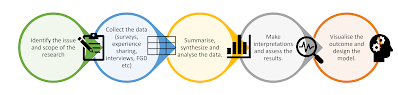
Process of creating Mental Model

  1. Identify the problem and scope,
  2. Collect the data through surveys, focused group discussions, interviews, or asking the experience of others. You can use your own experiences earned over a period of time. 
  3. Summarize and synthesize the data,
  4. Make interpretations and assess the results,
  5. Finally visualize the outcome and design the model based on the outcome.  

I recently created the “Industrial Relations Framework” based on the model and study, however I extensively used the research methodology. Please click here to read Industrial Relations Strategy Framework

(Opinions are purely personal & does not represent my organizations, current or past) 

Author's book are available on Amazon, Flipkart, Pothi and BookGanga. Income from books is used for social cause. 

Wish you all a happy X-mas and happy new year!

Sunday, June 27, 2021

Problem Solving: Avoiding solution that creates another problem

Long back in 2007, Mumbai Municipal Corporation had a problem with mice. Mice were dangerous and vulnerable to spread the Leptospirosis and plague that time. The solution proposed by the administration for exterminating the mice was to pay people Rs. 5 for every dead mouse they delivered. So the municipal corporation declared to pay Rs. 5 for every dead mouse. People had to take dead mice to the ward office of the municipal corporation and get the cash from there.  It worked until the people began breeding the mice in order to make more money.

"By solving one problem, we generate another one and sometimes create an even worse one. I have encountered similar examples where the people generated another bigger problem to solve one.

To pay the credit card bill, withdrawing the cash from another credit card is another example. The person has to face recovery agents and he used to hesitate to come into the office when recovery agents started visiting the workplace.   

To take a loan to invest in shares assuming that the returns on the share will make you richer. Few borrow the money to invest in Ponzi schemes like selling magnetic mattresses or buying the plot which nobody knows where it is and losing all money.

Problem solving without considering the future consequences is the common flaw in decision making. Every action has consequences, intended and unintended. No matter how carefully we plan, we can't anticipate everything.

To solve the traffic problem, most of the metro cities constructed overbridges. In Pune we have around 66 road bridges including bridges on the river. Our political representatives and engineers in the municipal corporation found that adding new routes and building bridges to distribute traffic will solve the traffic congestion issue. However, in certain parts of the city before or after the bridge, where roads divert, the new issue of traffic congestion is created which is much bigger that earlier one.

Most of the time, it depends upon what we want to achieve in the short term. In business, the top line or the bottom line is the dilemma. CEOs always say that both are important, and they want profitable growth. But depending upon the product mix, they have to decide some strategy. When your product becomes a commodity, your pricing strategy plays an important role. In that case you may improve the revenue impacting your profitability, but again to what extent you can afford it. We have similar issues in different areas of the business.

Few years back, some consultants and HR professionals came up with the idea of fun at the workplace to create an engaging workplace. Every service and technology company was doing some engagement cum fun activities on the shop floor. It created a feel good factor but could not solve the attrition and engagement issue.  Companies ignored the important imperatives of employee engagement like fair treatment, respect, empowerment, culture, right compensation and benefits etc. I am not saying that such engagement activities don't have an impact, it has a temporary impact and that may be on engagement score, but the fundamental problem remains as it is. In fact, it created another problem of the entitlement mindset. We assume that rewards and recognition schemes will increase the motivation, sales incentive plans will increase the sales and so on. Short term basis, it gives results but after a few months, or years it doesn’t work. Another consequence is employees expect gratification in everything you expect from them and it has an impact on the culture.

The problem is good intentions don't eliminate the bad consequences.. Outcomes don't follow from intentions and intentions by definition apply only to intended consequences.

So, what is the solution to such thinking? One way to reduce unintended consequences is to stop focusing on isolated factors and instead consider how our actions affect the whole system. Taking a holistic and helicopter view will help to eliminate some negative consequences in the long term.

You can use some tools while solving the problem or making any decision which will help you avoid some negative consequences.

Ask questions? What sort of problem do you want to solve? What are those positive or negative consequences? Ask somebody to play the role of “devil’s advocate” to challenge you. 

Design thinking: Understand what others expect, their perception and design the solution. Then test with the pilot and take the feedback. Redesign if required.  

Use Six Thinking Hats: Read Six Thinking Hats

Please click on below links to read articles for more methods and tools to avoid future negative consequences.

Weighted criteria assessment in decision making

Decision making process during VUCA

Do you consider the intuition while making decision?

"However, sometimes you make the right decision, sometimes you make the decision right. It depends on what benefits you see." 

(Opinions are purely personal & does not represent my organizations, current or past) 

Author's book are available on Amazon, Flipkart, Pothi and BookGanga 

Vitality in Human Resource is now available in paperback edition. Please click here to buy

Buy Industrial Relations Strategy Framework For Every Manager on amazon. Click IR Strategy Framework.

You may also like these.. please read